张枢 Shu Zhang
Assistant Professor | Institute of Energy, Environment and Economy, Tsinghua University

+86-10-62772759
北京市海淀区清华大学能科楼C203
Room C203, Energy Sciences Buildings
Tsinghua University
Beijing 100084, P.R.China
I completed my undergraduate studies at Tsinghua University with a B.Eng. in Electrical Engineering (supervised by Prof. Chongqing Kang ) and a B. Econ. in Economics. I earned my Ph.D. in Management (supervised by Prof. Wenying Chen ) at Tsinghua University. From March 2022 to April 2023, I was a visiting research scholar at the International Institute for Applied Systems Analysis (IIASA) (supervised by Prof. Volker Krey ).
My research interests include energy system modeling, water-energy-food nexus as well as energy and climate policy analysis.
news
| Aug 27, 2025 | I have been granted the NSFC Young Scientists Fund (C). |
|---|---|
| Dec 01, 2024 | We got a project of National Science and Technology Major Program. |
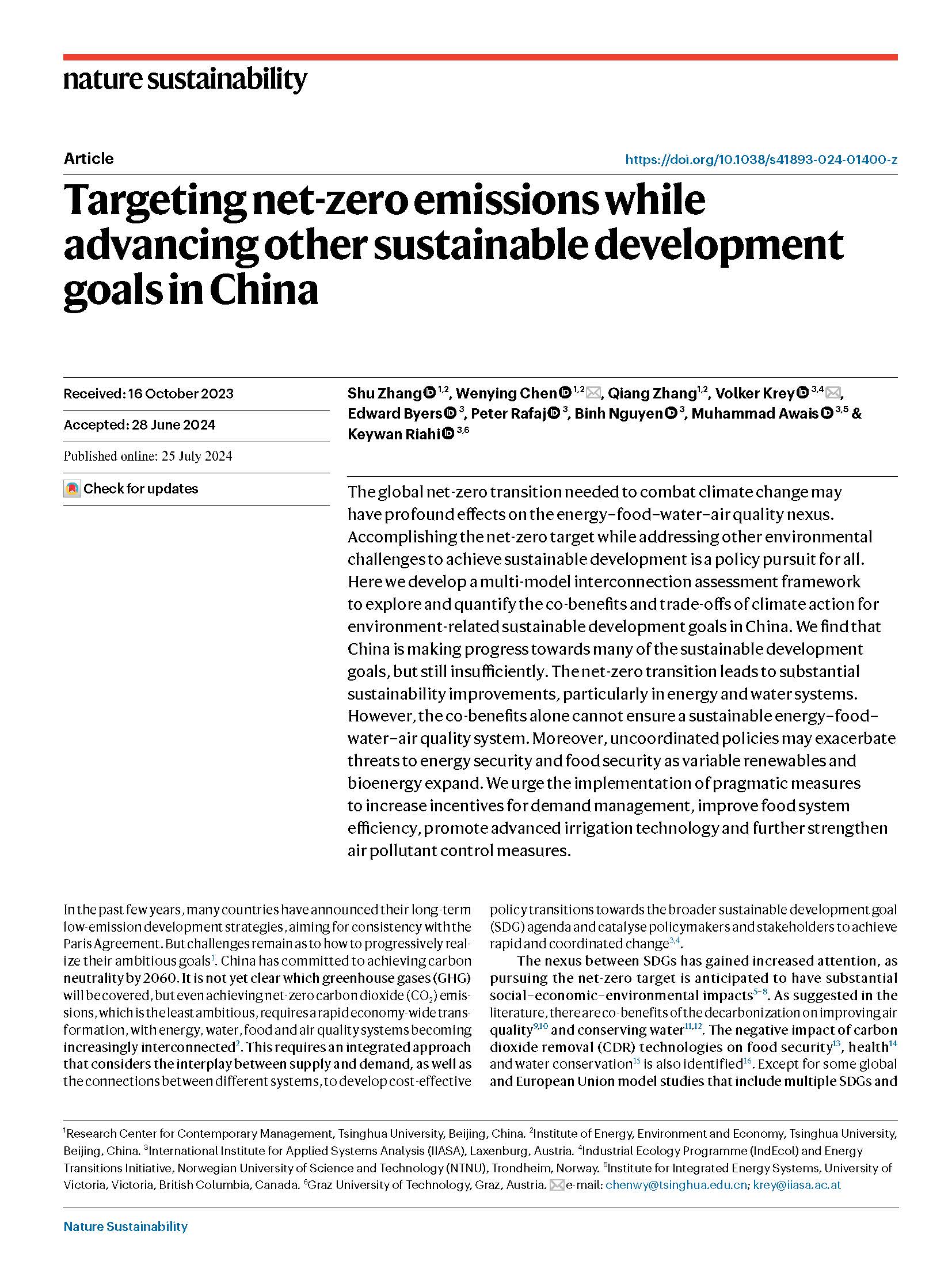
| Aug 27, 2024 | Nature Sustainability paper was featured. |
| Jun 30, 2024 | Today I am being awarded my doctorate. |